All posts in Blog

Creating a Healthy Home: Tips to Avoid Harmful Chemicals and Make Your Space a Healing Place

In the naturopathic profession, often one of the first challenges a doctor will tackle in working with a new patient is to determine and remove the “barriers to cure” – things that are interfering with the body’s ability to heal. In the past, I’ve written about treatments for common barriers to cure such as insufficient sleep, food sensitivities and seasonal allergies. I’ve learned through many patient experiences that no matter how amazing a medical treatment or how hard I work, a patient will be hard-pressed to truly heal as long as barriers stand in the way.

Often, some of the toughest barriers to remove are allergens and irritants in the home.  Chemical usage in home products has skyrocketed in the past few decades. Everything from laundry detergent to stain-resistant carpets, air-freshener sprays and synthetic-fiber bedding is a source of chemicals that put stress on our livers and immune systems. If you’re not aware of what I’m talking about, here’s a touching video from Healthy Child Healthy World that puts this issue into focus, especially as it impacts children (who are even more susceptible to the negative impacts of these chemicals than most adults).

My mother happens to be a Seattle-based interior designer with a fluency in eco-design and hypo-allergenic products for the home. While visiting her recently, I took some time to ask her for resources and tips she could share for those of us who are looking for ways to create a healthier home environment. The following are highlights from our conversation:

Q: What kinds of materials and treated fabrics are best to avoid in order to minimize chemical exposure?

A: Ideally, avoid anything synthetic. Synthetic materials, such as polyesters and acrylics, contain chemicals that can be harmful.  In addition to the material itself, these types of products are often treated with other chemicals to make them stain-resistant or otherwise “low-maintenance”. Unfortunately, buying convenience can also mean having to live with toxins that can be harmful to health. Terms like “easy care”, “water-repellant”, “no iron”, “anti-cling”, “static-free” and “flame retardant” are all signs that the product may be treated with harmful chemicals.

Q: What are some of the healthiest and least allergenic fibers to look for when choosing fabrics and floor coverings for a home?

A: The easiest rule of thumb is to stick with natural fibers. Linen, hemp, ramie, and abaca are all natural fibers that are hypo-allergenic and tend to be free from additional chemical treatments. When possible, look for organic textiles, not just organically grown materials, but products that are processed using organic-compliant compounds. Sometime a material will be organic, but then it’s processed with a harsh, non-organic dye and that can defeat the health benefits of sourcing the original organic material.

Q: In general terms, how to you suggest approaching the design of an eco-friendly and hypo-allergenic space?

A: Keep the space free of clutter where dust and allergens can accumulate. Opt for wood or tile floors and avoid carpet. Use natural fibers for window coverings, like wood-based plantation shutters instead of heavy fabric curtains. Optimize air circulation by strategically placing doors and windows to optimize air flow and utilize the air-filtering mechanisms of plants to improve air quality.

Q: Are there certain products, brands and resources you can suggest for people who are looking for products or just want more information on how to make smart choices when it comes to creating a health-promoting space?

A: The following are all great resources to check out:

  • O Ecotextiles is a Seattle-based textile company that creates luxurious fabrics that are non-toxic, ethical and sustainable. Not only do I love their products, but they are leading experts on this topic and their website has an incredible amount of information for how to make smart choices for the home.
  • Volatile Organic Compounds (VOCs) are harmful chemicals often found in paint and other home-based textiles. This site does a great job of explaining the dangers of VOCs, what products typically contain them and how they can be avoided.
  • Unique Carpets, Ltd. sells eco-friendly floor coverings made from natural fibers that are treated in an environmentally-safe way. If you are looking for floor coverings to soften a space, this brand is a great option to check out.

Like this post?

Image by Faith Sheridan Interior Design

Will “Obamacare” Improve Access to Preventative and Integrative Medicine?

Although passed into law back in 2010, The Affordable Care Act (ACA), a significant government expansion and regulatory overhaul of the country’s healthcare system, commonly referred to as “Obamacare”, is beginning to gain media attention once again as the October 1st enrollment date approaches.  A significant number of people (40% of Americans) not only don’t understand this legislation, but cannot even confirm that it is, in fact, law.  Although I am at least with it enough to know that it exists, I admit that the details of the ACA and what it will truly look like in practice is a source of confusion for me.  If you want to try and make sense of the ACA for yourself, you can find information here, here and here.

As a health professional, I support the idea of accessible healthcare.  As a naturopathic doctor, I also believe in the power of a preventative and integrative approach to medicine.  It’s with a belief in this approach that I am most interested to see how the complete roll-out of the ACA will ultimately make a mark on health, both financial and physical, in this country.

A specific clause of the ACA, Section 2706, is at the heart of both the preventative and integrative medicine debate.  This clause requires that insurance companies “shall not discriminate” against any health provider with a state-recognized license.  Again, coming from the perspective of a naturopathic doctor, this is a compelling statement.  Although I’ve been licensed and recognized as a primary care physician in California since 2005, participating as a provider through major health insurance plans has not been an available option for me.  Most plans cover traditional providers: MDs, DOs and perhaps RDs.  This means that although I have valuable, largely preventative and low-cost treatments to offer, they are out of reach to most people.  A $90, 30 minute visit is quite reasonable…unless you’re used to paying a $10 co-pay.

Given what I have been able to tease out of the research I’ve done on the ACA and Section 2706, it seems a more integrative approach to health options will largely be up to interpretation by each individual state.  Hopefully, overtime, and assuming the ACA survives long enough to truly become successful, best practices will emerge and states will adopt a more consistent approach to the delivery of preventative and integrative services.

A recent piece in The Washington Post interviewed a leader within the naturopathic community, Dr. Jane Guiltinan, about her predictions and hopes for the future of healthcare in our country as a result of this piece of legislation.  In the piece she quoted an often referred to belief in naturopathic care,

Health is more than the absence of disease.

If we really want to shift the status of health in our country, it seems a mental shift by insurance companies, state government and society at large may be required first.

Like this post?

The Genetically Modified Food Debate

I’ve been involved in understanding and tracking the topic of GMO (genetically modified organisms) in food crops for many years.  As an expert to the natural products industry, the issue of genetic modification and the role it should or should not play in natural products is a heavily debated (and litigated) topic.  You need look no further than the New York Times, the Dr. Oz show or your Facebook feed to get a dose of the polarized positions and emotions on both sides of this subject.

Over the course of these years I have come to a couple conclusions that I believe influence our ability to productively communicate about this issue: 1) Despite the rapidly growing debate on this subject, there is still an incredible lack of awareness about GMO and an even bigger level of ignorance about the various topics at play under the GMO label and, 2) the emotional intensity this topic carries with it makes education, understanding and rational dialog a seemly impossible task at times.

I confess that, on a personal level, I also have an emotional stake in this subject and wish for more information and understanding.  As a naturopathic physician and mom, I am troubled by conventional farming practices, the petro-chemical use required to keep it going and the seeming disregard for the natural wisdom of nature.  I worry about the global impact the spread of these farming practices into developing countries will have not only to the health of the soil and people but to the traditional farming wisdom that will no longer be passed from generation to generation.  On the flip side, I believe that as humans we are hard-wired to experiment, research and evolve our understanding of the world.  Given what I know of evolution and farming, biotechnology seems like a logical place for exploration in science.  It’s in the application of this science that things get complicated.  My sense is that, like most things, the best scenario for people and planet as it relates to GMO is toward the center from either side of the extreme.

Last week I came across a series of articles that are currently posting on Grist.org attempting to do the thing I’ve been hoping I would have the ability to do myself someday…investigate and dissect this issue without emotion and understand the impact of biotechnology in food crops on human and planet health.

Like me, the reporter, Nathanael Johnson, has been wishing for a rational dissection of this issue for many years.  I’ve spoken to some of the same people he’s interviewed for this series and am impressed by the depth of his research.  I’ve been reading and note taking as each of his articles are published and hope that if you’re also seeking to understand this complex issue, you will take the time to read his pieces as well.

You can find a link to the first article in his series here and can find links to subsequent articles in the series at the bottom of the piece.

Like this post?

Image by Steve Rhodes

Roasted Summer Vegetable Salad with Fresh Lemon Dressing

My mother happens to be a fabulous vegan cook, and while I was visiting recently she taught me the following recipe.  I’m so in love with it at the moment that I’m compelled to share it here.

For all my nutrition and health expertise I rarely ever cook (I know, the irony!).  However, this entrée-sized salad is so simple and low-maintenance that even I can do it while juggling kids and my own hungry stomach at the end of the day.  If you’re really in a rush at dinner time, you can roast the vegetables in advance so all you have to do is whip up the dressing and add the mixed greens.  That’s dinner in five minutes, Folks!

From a nutrition and health perspective, we all know vegetables are an excellent source of fiber and all the colors in this salad mean lots of antioxidant and phytonutrient compounds to protect our cells from damage.  You may also be interested to note that vegetables, on average, have around 14% protein.  That means this entrée is not only delicious and beautiful but packed with nutrition.

Servings: 4

Ingredients for salad

4 bell peppers, assorted colors
3 summer squash or zucchini
2 ears of corn
10 Fresh basil leaves, torn (optional)
6 cups mixed greens
Olive oil
Salt and pepper

Ingredients for dressing

Juice from ½ fresh-squeezed lemon
1/3 cup olive oil
1-2 tsp Dijon mustard
Salt and pepper

Directions

  1. Preheat oven to 425 degrees
  2. Chop peppers and summer squash into bite size chunks and corn into  approx. 1” disks
  3. Add chopped veggies into a large bowl and toss with liberal olive oil.  Salt and pepper to taste.
  4. Pour onto rimmed baking sheet and bake for 30 minutes, stirring once at about the ½ way point
  5. Once veggies are done, set aside and cool to room temperature
  6. To make dressing; whisk all ingredients together and add salt and pepper to taste
  7. When you’re ready to serve the salad, divide the mixed greens into large bowls, top with the roasted veggies.  Drizzle over dressing and sprinkle on basil.

Like this post?

Your Seasonal Guide to Food as Medicine: July Produce

I’ve decided that Mother Nature must have a serious sweet tooth.  That’s my only explanation for the ridiculous amount of sweet, luscious fruits in season in July.  If you’re a seasonal veggie lover, I’m sorry to say this month may not be for you (perhaps you can re-live the months of April, May or June).  However, if on the other hand you are a fruit-lover, well then please read on as not a single vegetable has made my list this month, just sweet, beautiful fruit!

As a naturopathic doctor, I’m always thinking about food as medicine.  Here’s my sample guide to what’s in season this month and how each fruit and berry supports the body.

Apricots – A source of vitamin C, beta-carotene and fiber, these sometimes tart little fruits are a nicely packaged dose of antioxidant protection.  To get the most health promoting bang for the buck with apricots, choose fully ripened fruit, when anti-oxidant levels are at their highest.

Figs – Perhaps you’ve been told to eat prunes for fiber?  Well, figs are another, and if I may say so, more beautiful option.  Although they can be eaten year-round in a dried form, a freshly sliced fig makes a beautiful and unique addition to any seasonal fruit or green salad.  If you’re willing to experiment, try making a tea with the leaves of the fig plant.  A study conducted on diabetic subjects found improvement in glycemic (blood sugar) levels by drinking one cup of fig leaf tea a day.

Currants – A berry that has fallen off the map in recent years, this little fruit brings a lot to your bowl of morning oatmeal or smoothie.  With a high level of protein as compared to other berries, currants also have all the vitamins and minerals you’d hope to find – vitamin C, potassium and magnesium.  And don’t forget the added bonus that comes with that beautiful dark purple color; anthocyanins.  This family of compounds provides anti-oxidant protection and has been researched for a variety of benefits from cardio-vascular support to anti-cancer protection.

Peaches – I simply cannot get enough peaches at the moment!  The look and taste of this fruit is summer personified and the fact that peaches not only contain a healthy amount of traditional antioxidants and fiber but some of the more newly discovered anti-oxidant compounds makes eating them even more rewarding.  Compounds (anthocyanins, clorogenic acids, quercetin derivatives, and catechins) found in both the skin and flesh of this fruit have a range of benefits, one of which may be to promote a healthy insulin and inflammatory response in addition to providing cardio-vascular protection.

Watermelon – If you’re heard of the health benefits of lycopene from tomatoes, then you may be interested to know that watermelon is another top source for this compound which has been researched most famously for its ability to support the treatment of Benign Prostatic Hyperplasia (BPH) and prostate cancer.  Another interesting note about watermelon is that contrary to what you might expect, the densest concentration of nutrients, including lycopene, are found at the outer edges of this fruit, next to and including the white rind.

Like this post?

Image by vpickering

The Incredible Benefits of Green Tea

Green tea is made from the leaves of the plant, Camellia sinensis, which is a beautiful but rather unassuming-looking plant native to Southeast Asia.  Interestingly, Camellia sinensis is also the source of white, oolong and black teas.  In fact, any naturally caffeinated tea is Camellia sinensis.

Beyond being a relatively common beverage, green tea is powerful medicine.  The research on this plant is wide-reaching and highly promising.  From acting as a mouth-wash to prevent dental cavities to reducing heart disease risk and all-cause mortality, it is about as close to a natural panacea as I can find (can you tell I’m a fan?).  But for all the promise green tea holds, it is for three specific reasons that I especially appreciate a cup (or four) of green tea each day:

Anti-anxiety – An amino acid compound, L-theanine, found in green tea has been found to have relaxing effects on the nervous system.  Studies suggest that L-theanine increases brain serotonin, dopamine, and GABA levels…all hormones associated with feelings of calm and wellbeing.  Given the fast-paced life most of us live in these days, a cup of calm and wellbeing sounds like a pretty excellent idea.

Stimulant – Similar to coffee, green tea contains caffeine.  Unlike coffee, however, green tea also contains other stimulant compounds beyond just caffeine.  The net effect of this broader spectrum of stimulants is a more gentle energy lift.  Whereas I often crave a cup of coffee to kick start my day, I find if I switch to green tea from there I still get an energy lift but avoid the narrow, zippy feeling that can come from too much coffee.

Anti-oxidant – The benefits of antioxidants are so broad and impressive, they really require their own post to do justice.  Suffice it to say, antioxidants delay aging, help prevent disease and prolong life.  And wouldn’t you know green tea happens to be packed with them.

So, to recap – a cup of green tea contains compounds that make you feel less anxious while simultaneously pepping you up and potentially extending the length and quality of your life.  See?  It’s about a close to a panacea as I can find!

If you’re new to green tea or have tried it and not liked it in the past, here are a couple tips:

  1. Have a tasting party and try some different brands and varieties.  From mild to bold, fruity to smoky, there are many options.  My current favorites are Gunpowder Organic Loose Leaf Green Tea from Teas Etc (it has a mild earthy flavor), or when I need bagged green tea on the go, I use Organic Green Tea from Trader Joe’s.
  2. Brew green tea between 140-180 degrees Fahrenheit.  If it’s too hot, it will be bitter and taste bad.  If it’s too cold, the flavor and medicine is not well extracted.  Here’s a site I found online with more brewing tips.

Like this post?

Image by Will Spark

My “Go-To” Sources for Natural Food and Health Information

Ever wonder where health experts get their “expert” information?  In my case, the foundation of my expertise comes from my medical training and the continuing education I’m required to receive to maintain my license.  However, the information provided at a few medical conferences a year rarely keeps pace with the rapidly evolving natural food and health landscape.  If you add trends and politics into the mix as I do, it becomes crucial to expand information sources beyond just journals and lectures.  When you enter the World Wide Web for natural health information, teasing apart reliable from let’s call it “interesting interpretations” can be challenging.  Here’s a list of some of my favorite sites for health and nutrition information.

Food Politics – This blog, written by Marion Nestle, Professor in the Department of Nutrition, Food Studies, and Public Health and Professor of Sociology at New York University, is often my first stop of the day for news.  She has a keen sense for the interplay between food, American diets and policy and I appreciate her willingness to say it like she sees it (for an example of this, just click on “Coca-Cola” in the word cloud running on the side of her blog).  It’s a refreshing change from other sources that are often slanted to the point of losing credibility in this area.

Civil Eats – This site is also a great source for news on challenges and successes in the food movement. Written with a broader scope than Nestle’s blog, Civil Eats steps away from Washington DC to look at what’s happening on a community level. From ethical sourcing of cocoa to fracking, this site is a great source for a general swath of updates on the diverse range of subjects under the label of “sustainable food systems”.

Natural Standard – This is a subscription site, but one that’s value easily offsets the cost to join.  I often use this site to verify information I’m seeing online in other sources.  With monographs on an amazing range of botanicals and nutrients, I always feel a bit like I’ve uncovered buried treasure when searching around this site and have to remind myself that I don’t have to frantically copy and save everything I see in case it disappears.  Another thing I love about this site is that the sources are often hyperlinked right to the original research.

MindBodyGreen – I was introduced to this site rather recently and have really been enjoying it.  It’s well named, with most of the content focusing on the connection between mind and body.  For example, I’ve found many great articles recently on the benefits of meditation to improve a range of conditions, and although the articles on this site are not typically referenced with primary research, it’s a great lead for where to do more digging.   One caution is that it does have a yoga slant, however, I believe the information is still valuable regardless of whether or not you practice.

If you have any other news sources in the natural food and health space you think are worth sharing, I’d love to check them out, so please share them in the comments section below.  Cheers!

Like this post?

Image by wenzday01

Your Seasonal Guide to Food as Medicine: June Produce

In the process of writing seasonal guides to food as medicine for the past few months, I’ve gained a whole new appreciation for the bounty of late spring and summer fruits and vegetables.  The colors!  The variety!  The sweet juicy fruits!  The fruits! (Fruit deserves a second call out).  I’m a bit worried that because I started this process in the spring, I’m in for a rude awakening when winter rolls around.  Starchy root vegetables seem so boring at the moment when compared to the vibrant colors I see at my farmers’ market visits these days.

With so much to choose from, this month required less in the way of searching for material and more in simply choosing which beautiful and powerful plants to highlight.   Here’s a sample of what’s in season in June and how each fruit and vegetable supports the body.

Poblano Peppers – In Central and South America, peppers, and in particular, Poblanos have been a traditional element of the diet for thousands of years.  They’ve long been recognized as a significant source of nutrients such as beta-carotene and other vitamins as well as chlorophyll.  Recent research is now investigating how these compounds may be working together to block mutations in the human body, providing an anti-cancer mechanism.

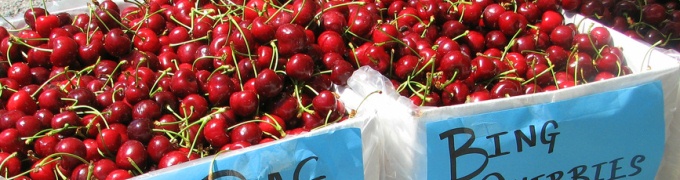
Cherries – One of the highlights from my time living in the Pacific Northwest was the arrival of Bing cherry season.  Although varieties of cherries can be found as far away as Africa, there’s something so amazing about the taste of a sweet, beautiful Bing cherry.  And cherries aren’t just about good taste and looks; research suggests they may have a surprising range of health benefits in the body.  From acting as a medicine for Benign Prostatic Hyperplasia to relieving exercise-induced muscle damage to containing a spectrum of anti-inflammatory and anti-cancer compounds, cherries bring serious medicine to your slice of cherry pie.

Blackberries – Along with traditionally recognized vitamins and antioxidants such as vitamin C and folic acid, blackberries provide anthocyanins, compounds that not only provide this berry’s beautifully rich color but additional antioxidant and astringent activity.  Compounds found in blackberries may help  tonify tissues and small vessels called capillaries, providing benefit for edematous conditions such as lower extremity swelling and varicose veins.  A 2006 study found that a compound in blackberries may also provide anti-cancer protection.

Pineapple – The next time you chop into a pineapple, consider hanging onto the white, center stem.  Bromelain, a digestive enzyme, is found in highest concentrations in this portion of the fruit and has been shown through research dating all the way back to the 1950s to be an effective treatment for inflammatory conditions such as sinusitis and various forms of arthritis.  Emerging research suggests it may be a useful aid to support treatment of pancreatic insufficiency and advanced cancer.

Kale – This leafy green is just one of six modern vegetables derived from the same wild plant, called colewort.  Collard, cabbage, Brussels sprouts, broccoli and cauliflower have also been selectively bred from colewort and it’s for this reason that these vegetables have a similar flavor profile and medicinal qualities.  Kale and its siblings contain a wide range of vitamins, minerals, fiber and most-famously sulfur-containing compounds that in addition to providing a distinct smell have a growing body of research demonstrating anti-cancer and liver-protecting activities.

Like this post?

Image by Wildcat Dunny

Breeding The Medicine Out of “Food as Medicine”

I’m really excited about a book releasing next week titled, Eating on the Wild Side, by Jo Robinson.  Robinson is not a formally trained health professional or PhD but an investigative journalist (BTW…is anyone else noticing that journalists seem to be the new “go-to” source for natural health and food movement expertise?) who’s clearly passionate about the interplay between people, food and the results of what’s happened overtime as we’ve selected plants to meet our cultural preferences.  An excerpt from a New York Times piece she wrote this week:

Each fruit and vegetable in our stores has a unique history of nutrient loss, I’ve discovered, but there are two common themes. Throughout the ages, our farming ancestors have chosen the least bitter plants to grow in their gardens. It is now known that many of the most beneficial phytonutrients have a bitter, sour or astringent taste. Second, early farmers favored plants that were relatively low in fiber and high in sugar, starch and oil. These energy-dense plants were pleasurable to eat and provided the calories needed to fuel a strenuous lifestyle. The more palatable our fruits and vegetables became, however, the less advantageous they were for our health.

And an excerpt from a summary of her book I pulled from Amazon.com:

..400 generations of farmers have unwittingly squandered a host of essential fiber, protein, vitamins, minerals, and antioxidants. New research shows that these losses have made us more vulnerable to our most troubling conditions and diseases–obesity, diabetes, cancer, cardiovascular disease, chronic inflammation, and dementia.

I had the opportunity to sit in on a rather informal chat with Robinson and Dr. Andrew Weil a couple weeks ago and listen as she described her research process behind the book as well as some of the discoveries she found most interesting while compiling information for the text.

In addition to the historical information, which is fascinating and reminds me in many ways of another awesome book, The Botany of Desire, by Michael Pollan, Robinson was full of super practical tips for improving the nutritional content of the food we do have to choose from today.  You can find a list of 12 tips here, but just to give you a taste (pun intended):

  • Tearing Romaine and Iceberg lettuce the day before you eat it quadruples its antioxidant content
  • Storing broccoli wrapped in a plastic bag with tiny pin pricks in it will give you up to 125% more antioxidants than if you had stored the broccoli loosely wrapped or in a tightly sealed bag
  • Thawing frozen berries in the microwave preserves twice as many antioxidants and more vitamin C than thawing them on the counter or inside your refrigerator

Her book is available now for pre-sale and formally releases June 4th.

Like this post?

Image by Suzies Farm

How to Celebrate Salad Month + Memorial Day? Eat Awesome Salads!

Not only is Memorial Day just a few days away but May also happens to be National Salad Month!  I couldn’t have picked a better month to celebrate salads myself, so in honor of beautiful produce everywhere I thought I’d share a few recipes that are not only perfect for a holiday picnic or barbeque, but are packed with phytonutrients.

Springtime Carrot Slaw – This easy vegan take on coleslaw is not only a more colorful play on the traditional version but provides vitamin C, beta-carotene, healthy fat and loads of fiber.  The mix of different cabbages in this recipe also means a broader spectrum of glucosinolate compounds which support detoxification in the liver and may protect against cancer formation.

Strawberry Mint Salad – I cannot get enough strawberries right now, so this simple vegan salad is an excellent excuse to pile my plate high.  The red onions in this recipe contain quercetin, a compound with anti-inflammatory, antioxidant and anti-allergic properties.  The natural oils found in the mint leaves are widely used for digestive conditions such as Irritable Bowel Syndrome (IBS) and indigestion.  Depending on what else you may be eating this holiday weekend, mint may be a nice ingredient to have nearby.

Goat Cheese Creamed Dandelion Greens with Nectarines – I’ve written about the benefits of dandelion greens before, and in this recipe they also provide benefit by acting as a bitter ingredient to stimulate digestive enzymes and support effective digestion.  The pairing of sweet nectarines and goat cheese provides both a great mix of flavors and textures and also makes this salad a bit more substantial as a side-dish.  If you have trouble finding a pure source of stevia, you can always substitute a different sweetener such as maple syrup or ethically sourced honey.

“This nation will remain the land of the free only so long as it is the home of the brave.” -Elmer Davis

Like this post?

Image by the Bombshell Blueprint